Alas, poor Mabel

Morello Cherry blossom Blossom on the morello cherry. Dreaming of cherry pie… Look, lots of these pictures are random ones taken in my garden today, to give you something pretty to look at while I bash on about Gardening: My Thoughts. Your visit is very important to me and so on…

On our way back from the country a few weeks ago, Lady de B  and I took a detour to the most magical nursery, Wootten’s, in Halesworth, Suffolk.

It was a drippy, grey and misty sort of afternoon so we retreated to the glasshouse and a feast of pelargoniums of every imaginable type. Our senses, dulled by too little sleep and too much chablis, awakened. We trawled the aisles, sniffing foliage, holding little black pots up to the light to admire the delicate leaves.

I was drawn to the sherbet-y, dainty Queen of the Lemons, not just for its hangover-banishing aroma, but for the description on its label.

PELARGONIUM Queen of the Lemons

Scented leaf. Mauve flowers April – Oct. Sage green rounded leaf with delicious sweet lemon scent. Much more refined than the rather coarse Mabel Grey
.Queen of the Lemons The Queen herself.

Poor Mabel! What had she done? Made the mistake of wearing diamonds in daytime? Displayed an extensive collection of fish knives? Asked to use the toilet?

But I brought home my Queen, and a few courtiers, feeling rather smug at my refinement by association.

Euphorbia Cheering euphorbia

When I first started gardening a dozen or so years ago, I had no idea that this most gentle of activities was as riven with snobbery, beset by fashion, as everything else. I was just relieved if I got through a season without slaughtering the Innocence (that’s Collinsia verna to you).

I was a newlywed. I had a few pots on a Marylebone roof terrace and big dreams. I wandered innocently into the garden centre, picked up some packets of seeds that looked pretty and hoped for the best. I made all of the beginner’s mistakes. I planted too quickly and too thickly, a little bit of that here, a little bit of this there, with little regard for what sort of conditions each plant needed.

But gardening quickly became an obsession. I amassed books by the stout-of-shoe and stout-of-heart. Margery Fish, Rosemary Verey, Penelope Hobhouse, Beth Chatto – the glorious sorority soon crowded my bedside table. I knew my addiction was serious when most of the books I read became text-heavy and picture-lite. At one point, poor Séan considered suing the late Christopher Lloyd for alienation of affection as his Well-tempered Garden was never out of my hands.

Cheery tree The ornamental cherry, one of the few things in the garden when we bought the house.

James Grieve

Bramley Blossom on the James Grieve & Bramley Apples.

Walthamstow Wonder My Walthamstow Wonder is sprouting,
delighted that I haven’t killed it yet.

In winter, there were catalogues to study. Not just any old seed catalogues either, but specialist pamphlets, most with no vulgar pictures to distract. These are top-shelf material for gardeners, the things that put ‘cult’ into horticulture. Any plant described as ‘rare’ or ‘seldom offered’ is our hard core. The idiosyncratic descriptions warm the chill of winter: ‘Mrs Fish acquired her plant during rationing in exchange for a quarter of tea’ (Glebe Cottage’s description of the Polemonium ‘Lambrook Mauve’); or ‘the whip-like tips of small brown arum flowers look like the rounded backsides of mice’ (Beth Chatto on Arisarum proboscideum).

I joined the Royal Horticultural Society and attended their shows in Vincent Square. They really are marvellously comforting, like a big church fête in one of the better parts of Gloucestershire. They’re crammed with thoroughly decent people in sensible clothes which run the full colour spectrum, from oatmeal through khaki to nut brown.

Euphorbia martini Euphorbia martinii, with Geum Mrs Bradshaw in the background. Very unrefined clashing, but there you are.

I soon realised how naïve I’d been in my smash and grab raid of garish seed packets. Flowers are the obsession of the amateur. Those gaudy geraniums (which I now knew to call pelargoniums), non-stop busy lizzies and flowing petunias were the horticultural equivalent of top-to-toe acrylic. Foliage was where it was at: hostas, ferns, euphorbias were the thing. Colour was tricky. Gentle, blending colours with perhaps the odd well-thought-out surprise acquired from Great Dixter were just about allowed.

I met people who played it so safe they drained all of the magentas, mauves, golds, oranges and reds from their gardens to the point where they contained hardly any colour at all, “except, of course, green, which really is the most complex and thrilling colour of all,” they claimed.

Shriek pink bergenia Shriek pink bergenia

These gardenistas visited Vita Sackville West’s White Garden at Sissinghurst as though it were Lourdes, designed to cure them of any longing they may have had for gaudy, waxy begonias or shriek pink rhododendrons. In Vita, they found their high priestess.

As if to underline her peerless good taste, Sackville West’s husband, Harold Nicholson, once said of her, “Vita only likes flowers which are brown and difficult to grow.” Which brings us to difficulty of cultivation, demonstrated never more strongly than with roses.

For decades, able and dedicated people have sweated to bring us roses which are disease resistant, flower continuously and behave sensibly. These blooms can have names like Radox Bouquet, Sexy Rexy, Disco Dancer, Pretty Polly or Rhapsody in Blue. Are we grateful? We are not. In our quest for chic, we want roses that were bred before 1900 and are magnets for mildew, aphids and black spot. Ideally, they will have names beginning ‘Gloire de…’, ‘Comtesse de…’ ‘Souvenir de…’ and many of them will flower once, for about ten minutes, so long as it isn’t raining too hard, and probably when we’re on holiday.

True style, in gardening as in everything else, is elusive – a shifting, spectral thing. As soon as you feel like you have a handle on what’s cool, all the big kids have moved on. So there you are, stuck with the knot garden, prairie border and bed of exclusively black plants, looking like Daniella Westbrook in top-to-toe Burberry.

Rhubarb My rhubarb is in rude health.

Stawberry flower The last few days’ sunshine has delighted the strawberries.

Even the vegetable patch has not escaped the style mavens’ attention. Of course, you could have a few scrubby rows of leeks, or you could have a potager overflowing with fruit, vegetables, herbs and flowers. And it’s very important to grow the most exquisite varieties, selected after hours studying Sarah Raven’s Cutting Garden catalogue as if it’s the kabbalah. Obviously, you won’t miss out Bright Lights chard with its orange, yellow and scarlet stems. And your salads will glitter with dainty Heartsease violas, Indian Prince marigold petals and mahogany nasturtiums. No iceberg lettuce for you, but choicest mizuna, pain de sucre and merveille de quatre saisons. Say it softly, it’s almost like praying.

But despite all of this, gardens are freedom. They are the buffer zone between us and crazy. In a world full of ‘instant’, gardening forces us to be patient and rewards us with a glimpse paradise. You may never own an Old Master, but you could cram some tulip bulbs into an old terracotta pot. Within a few months, you will have display to rival any Vermeer. And really, who cares whether it’s in this year’s colour or not?

Scabious This scabious began flowering in February,
as soon as the snow melted.

Not a Ballerina! This is supposed to be Ballerina. The perils of buying your tulip bulbs from open bins in Columbia Road market. I think naughty gardening sprites go around mixing them all up so, a few months later, surprise!  Any idea what it is?

A Sunday morning in spring

Columbia Road Daffodils

Finally, our fruit trees arrived – two espaliered apples, a Bramley Seedling and a James Grieve, and a fan-trained Morello cherry.

Our garden is quite small, about 20 feet by 50, standard issue for a London terrace. It slopes upward slightly at the back, as many London gardens do. During the great housing rush at the end of the Nineteenth Century, builders seldom took away their rubble. They just slung it all into a heap at the far end of the garden and covered it with a bit of soil, before racing onto the next house, the next street, the next parcel of profit. When I’m digging, I often turn up an odd fragment of blue and white china or chunks of thick, greenish bottle glass among the broken bricks and shattered slates. Once we even found a stoneware flask from a local wine and spirit merchant.

Columbia Road - Pot

We built a deep, raised bed along the back fence of the garden, open to the ground, for the apple trees. Séan hauled 40 litre sacks of topsoil, 34 of them, through the house to fill it. We planted the trees. I thought they looked majestic, like sails. Our neighbour Paul thinks they look crucified. He has a point. With their two, parallel rows of horizontal branches they do resemble a pair of Orthodox crosses on an altar. In a few weeks, frothy blossom will soften their austerity.

We spent most of the weekend in the garden, tidying, weeding, encouraging the roses’ new shoots over the pergola. We joined the masses at, well, the closest lots of Londoners get to Mass: Columbia Road Flower Market. In that narrow street, for a few hours on Sunday morning, spring is in riot.

Columbia Road - Window A house at the entrance to the market.

I always start my floral pilgrimage in the little courtyard off Ezra Street, where they sell the best coffee in the world, and that’s official.

Columbia Road - Gwilyn's coffee

I can’t decide whether these oysters are the breakfast of champions…Columbia Road - Oysters

Or this chorizo sandwich?Columbia Road - Chorizo sarni

Barney Barney, meanwhile, holds out for a sausage.

Séan's Chair A chair on Sean’s stall (no, not my Séan).

Baguettes from the French cheese stall

Not an ordinary bin!

Columbia Road - Olives

Columbia Road - Bits and bobs I can’t believe I resisted the temptations of this
book by M.E Gagg…

Columbia Road - pots Or these pots.

Suitably fortified, we edge our way into the market.

Columbia Road

Every week, I buy my flowers from Carl. He has the most interesting selection and they’re the best in the market. They always last for at least 10 days; I tell him this must be bad for business.

Columbia Road - Carl Grover Carl’s stall

 Columbia Road - Tulips Tulips

Columbia Road - Roses Roses

Columbia Road - Cherry Blossom Cherry blossom

Columbia Road - Mimosa Mimosa

My garden, kitchen and cooking owe much to the wonderful herbs, fruit and vegetables bought from Carl’s lovely mum and dad, Mr and Mrs Grover, who have had a stall in the market for more than 35 years.

Columbia Road - Grover's herbs Mr and Mrs Grover’s herb stall.

Columbia Road - Grover's Mint Mint

Columbia Road - Grover's Thyme Thyme – how could you resist running your fingers through it?

Columbia Road - Rhubarb Tiny rhubarb plants, pies in waiting.

And onwards into the rest of the market…

Columbia Road stall Hyacinths, cyclamen and primroses.

Hyacinths Before…

Hyacinths … and after.

Cyclamen Tiny cyclamen petals, like butterfly’s wings.

Daisy Cheerful little daisies.

Perennials Perennials in their clods of earth
‘What will I be when I grow up?’

A bowl of cheerfulness

Lentil Soup
I spent a wonderful, woolly-jumpered day yesterday planting my tulips (fiery orange Ballerina and deepest purple Queen of Night for the back garden and pretty, stripy Spring Green for the front), lots of pom-pomy purple alliums and a huge basketful of Cheerfulness, that most appropriately named of daffodils.

And, thrillingly – to me, at least – I dug over beds, tugged out tough old roots and bits of rubble to make spaces for my new fruit bushes, Malling Jewel raspberries, Ben Lomond blackcurrants and Versailles Blanche whitecurrants. I could plant them for their names alone. I know, I know, it’s the horticultural equivalent of picking a horse because you like its name or the colours of the jockey’s silks, but I’ve funded many a day at the races that way (much to my form-following friends’ annoyance) so I hope this little experiment will prove just as successful.

It’s been a blustery old weekend so I retreated to the kitchen often, covered in muck and virtue, to warm up a bit and give my soup a stir.

Trolling the aisles of Waitrose the other day, I found an intriguing bag of pulses, Cerreto’s Organic Minestrone with Kamut Soup mixture. I love beans and pulses, not just for their beautiful names – adzuki, borlotti, cannellini, flageolet, haricot (cf plants, horses) – but for the way they look like tiny, brightly-coloured sea-washed pebbles while soaking in their bowl of water; their toothsome texture in soups and salads and the amiable way in which they take on the flavours of their culinary companions. They’re perfect for winter soups like this one…

Winter minestrone

Lentil Soup - Spooned

I hate to throw anything out until I’ve squeezed the last glimmer of possibility out of it. When I’ve grated Parmesan down to the rind, I bag the rind up and pop it in the freezer to add flavour to soups later on. And I’m afraid my thrift doesn’t end there – when I’ve fished it out of the soup, I dry it out and cut it into tiny morsels which become Barney’s favourite treat ever, even better, I’m afraid to say, than Doggy Breath Bones.

You need to start this soup the day before, by soaking the beans and pulses, but after that it’s simplicity itself.

Serves 6.

1 tbsp olive oil
3 slices of unsmoked bacon or pancetta cut into 2cm pieces
2 onions, finely diced
2 carrots, finely diced
1 stick of celery, finely diced
3 cloves of garlic, halved and finely sliced
1 500g packet of Cerreto Organic Minestrone with Kamut Soup mixture (or your own favourite combination of dried peas, barley, lentils, red lentils, kamut, chickpeas, black beans, green adzuki beans, cannellini beans, haricot beans, red kidney beans) soaked in plenty of cold water for 12 hours
1 bouquet garni – a few stalks of parsley and some sprigs of thyme tied together with a bay leaf
2.25 l good chicken or vegetable stock
Parmesan – a rind for seasoning if possible, some more for grating over the top
A handful of parsley leaves, tough stalks removed and finely chopped
Some fruity extra virgin olive oil for trickling over the top
Salt and freshly ground black pepper

Warm the olive oil in a large saucepan over a medium heat. Add the bacon or pancetta and fry until they just begin to take on some colour. Remove it from the pan and set aside while you sauté the vegetables in the oil and bacony fat. Lower the temperature a bit and add the onions. Cook them very gently until they’re soft and translucent, about 15 minutes. Add the carrots and celery and cook, stirring, for about 3 minutes. Add the garlic and cook for a minute. Drain the beans and add to the pot with the bacon or pancetta, bouquet garni, stock and Parmesan rind if using. Simmer very gently, partially covered, for 2 hours. Stir the soup from time to time and top up with a little boiling water from the kettle if it looks a bit dry. The beans should be very tender. Remove the Parmesan rind and bouquet garni. Stir in the parsley and season well with salt and lots of black pepper. Ladle into warmed bowls, grate over some Parmesan and trickle on a little good olive oil.

Treesons to be cheerful: Part one

A seed hidden in the heart of an apple is an orchard invisible.
Welsh proverb

Walthamstow Wonder Leaves Pink-tinged leaves of the Walthamstow Wonder

Our friend Phil went on a tree grafting course and the result was this apple sapling, variety Walthamstow Wonder. Never heard of it? No, neither had I. That’s because it’s a newly discovered variety and my little twig is one of only a handful in existence. Its mother tree was found growing in an old lady’s garden in Walthamstow and extensive investigations to discover what it was were, shall we say, fruitless – though the tree itself bore much fruit, delicious apples with juicy, pink-tinged flesh.

Walthamstow Wonder on M76 root stock
Phil grafted a scion from the old lady’s tree onto crab apple rootstock and the graft took. Unluckily for him but luckily for us, he doesn’t have space for it in his own garden so he gave it to us. I really think that if there are people on this earth whose innate beneficence matches the boundless generosity of cooks, it’s gardeners. Just as I’ve seldom visited the house of a keen cook without coming home with lovingly wrapped leftovers or at the very least a new recipe, so I’ve seldom said goodbye to a keen gardener without a few cuttings or seeds tucked into my bag.

So here I am with my rare specimen. I am delighted and terrified in equal measure. It needs to stay in a pot for a couple of years before it can be planted out and in that time, I have the onerous responsibility of protecting it from drought and flood, scorching sun and withering frost, pests and pets. But I’m thrilled. Is there any human activity more optimistic than planting a tree? Any more profound demonstration of trust in a benevolent future? My Walthamstow Wonder may be little more than a twig but – in its 20 or so leaves – I spy spring mornings sparkling with frothy blossom and autumn afternoons fragrant with pink-tinged pies, tarts and crumbles.

The Sapling

Remembrance of cakes past

On Sunday, we went to Columbia Road Flower Market . It was so crowded, it being both gloriously, unexpectedly sunny and Mothers’ Day, I swear that at one point in the crush someone was trying to remove my kidney.

I jostled through the bouquet-toting masses (or should that be, massive) to Carl’s stall where I buy my cut flowers each week. His rows of jewel-coloured tulips, ranunculus, hyacinths and anemones looked tempting as an old-fashioned sweet shop and there, right in front, yellow and fluffy as day-old chicks, were armfuls of mimosa.

Mimosa’s sweet, clean, slightly briny smell always pulls me back to the Easter when I was 13 and staying with Laure, my French exchange. Each morning, I unwrapped myself from the cool linen sheets and stumbled in inky darkness to the windows. I opened the heavy shutters and the brilliant light of the South West flooded the room. The scent of the mimosa tree below was the first thing I smelled each day. Heady stuff for the girl from County Durham.

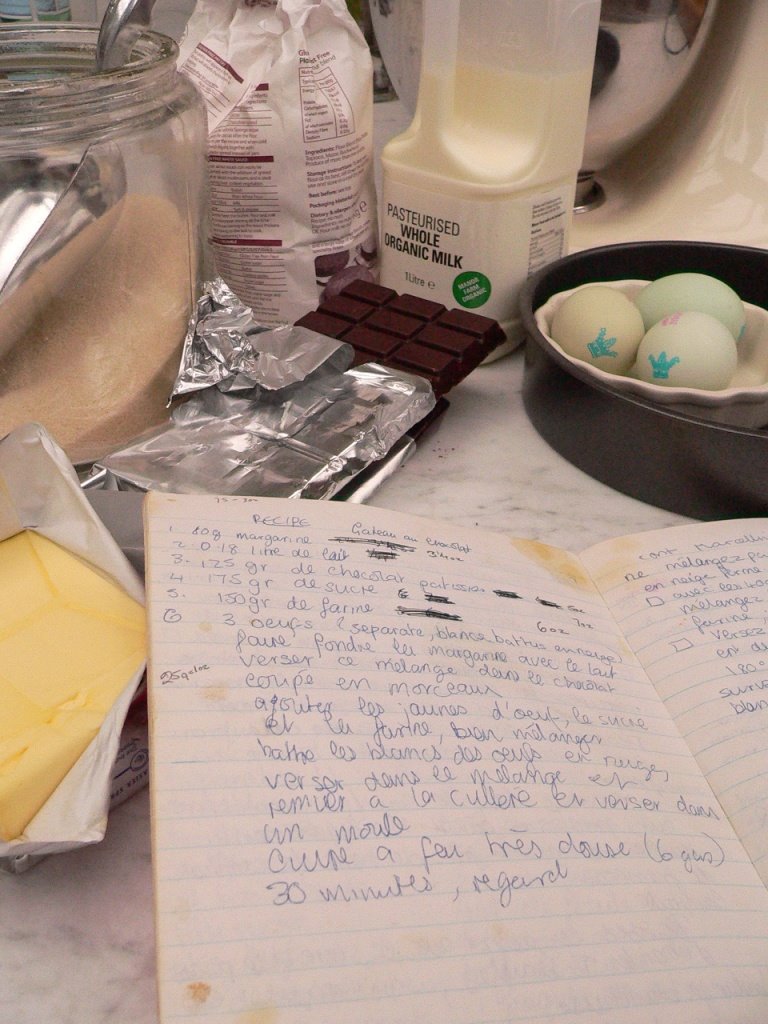
As you know, food was not the most important thing in our house. And yet there I was, cheating on my parents by falling so willingly, so wantonly in love with this home where dinner formed its beating pulse. I was the first to volunteer to collect the bread from the bakery, wandering back along the dusty path with the baguette under my arm, nibbling a few crumbs from its end as I went. I happily whisked vinaigrette for the salad, carefully measuring out three spoons of olive oil to one of red wine vinegar and just the right amount of mustard. I watched carefully when, after dinner, Madame threw together a chocolate cake for the following evening’s dessert.

A few months ago I found the little exercise book I’d filled during my trip. I wanted to hug my sweet, earnest 13-year-old self when I read this:

‘I wonder what I really will do! And I wonder what the me of 5 years time will think of this dreamy 13 year old who has many ideas but whose main fault is lazyness. Next term at school I will try to work harder. I say that every term.’

Intoxicated by my mimosa-madeleine-moment, I thought I’d make Madame Sarrodie’s chocolate cake and it was just as good as I remembered – rich and fudgy, with a crispy top, like the best brownie. I did tinker with it a bit (I can’t help myself), replacing margarine with butter and adding a little vanilla and salt.

I was also inspired by a great article by Xanthe Clay in The Telegraph on how to make killer brownies. In her quest to create the perfect, dense interior and crackled top, she gleaned a great tip from American Queen of All Things Chocolate, Alice Medrich. She advises taking the brownies out of the oven and immediately plunging the tin into iced water to stop the cooking process. I wanted to try this with my cake and was all ready to go, the sink bobbing with ice cubes, when I remembered I’d used a loose-bottomed tin. I managed to stop myself just in time, but if you use a simple cake tin, or next time you make brownies, do give it a go and let me know how you get on.

Madame Sarrodie’s chocolate cake


80g unsalted butter, plus a little more for greasing
180ml whole milk
125g dark chocolate, about 70%, broken into small pieces
175g caster sugar
3 eggs, separated
150g plain flour, seived
½ tsp vanilla extract
A good pinch of salt

Cocoa or icing sugar for dusting if you like

Preheat the oven to 180C/350F/Gas mark 4. Butter a 22cm, loose-bottomed cake tin then lightly dust it with cocoa.

In a saucepan over a low heat, melt together the butter and milk. Remove from the heat and add the chocolate. Leave it for a minute and then beat until smooth. Add the egg yolks one at a time, beating well after each addition, then add the vanilla and salt. Next, gently fold in the flour until just combined.

Beat the egg whites until stiff then gently fold them into the chocolate mixture with a spatula or metal spoon. Pour into the prepared tin and bake for 30-35 minutes, or until a toothpick comes out with a few moist crumbs clinging to it. Leave on a rack until cool enough to handle, then remove the tin and cool completely before cutting. You can dust it with icing sugar or cocoa if you’re having a fancy day.

TIP
When I’m baking chocolate cake, I dust the baking tin with cocoa rather than flour – you get the non-stickability, without the whitish floury film which spoils the look of your cake.

LICKED
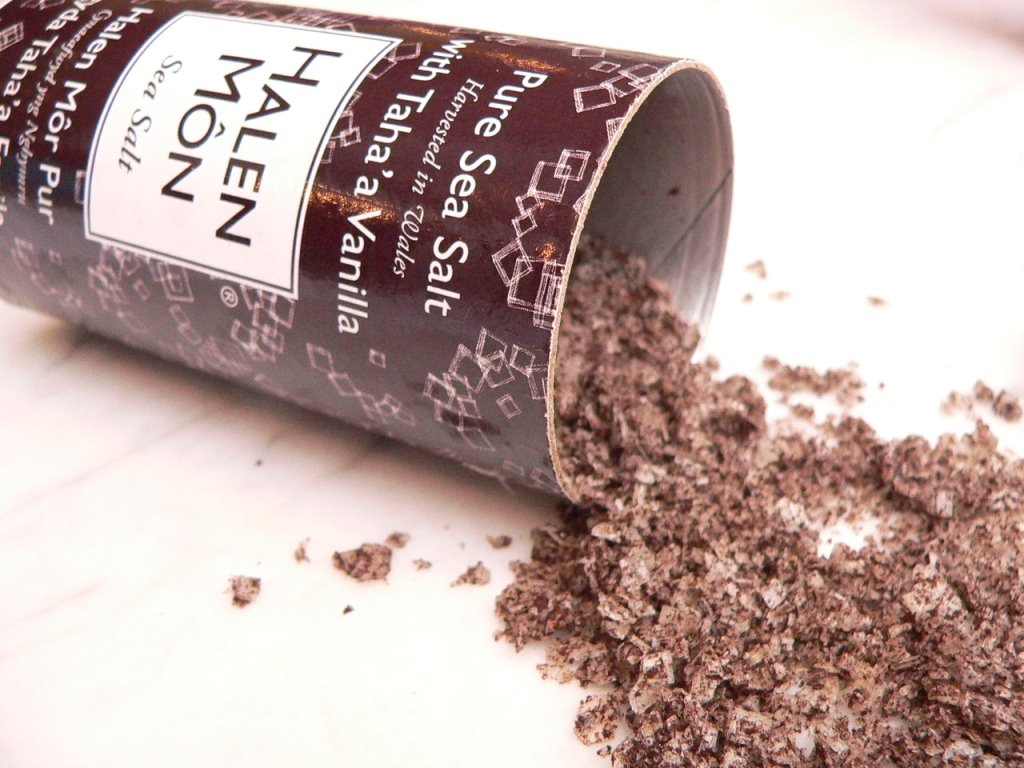
Most sweet things benefit from a pinch of salt, and when I’m cooking with chocolate, I love to use this beautiful vanilla sea salt from Halen Môn , in Anglesey, Wales. It’s good, in very small doses, with scallops, too.